
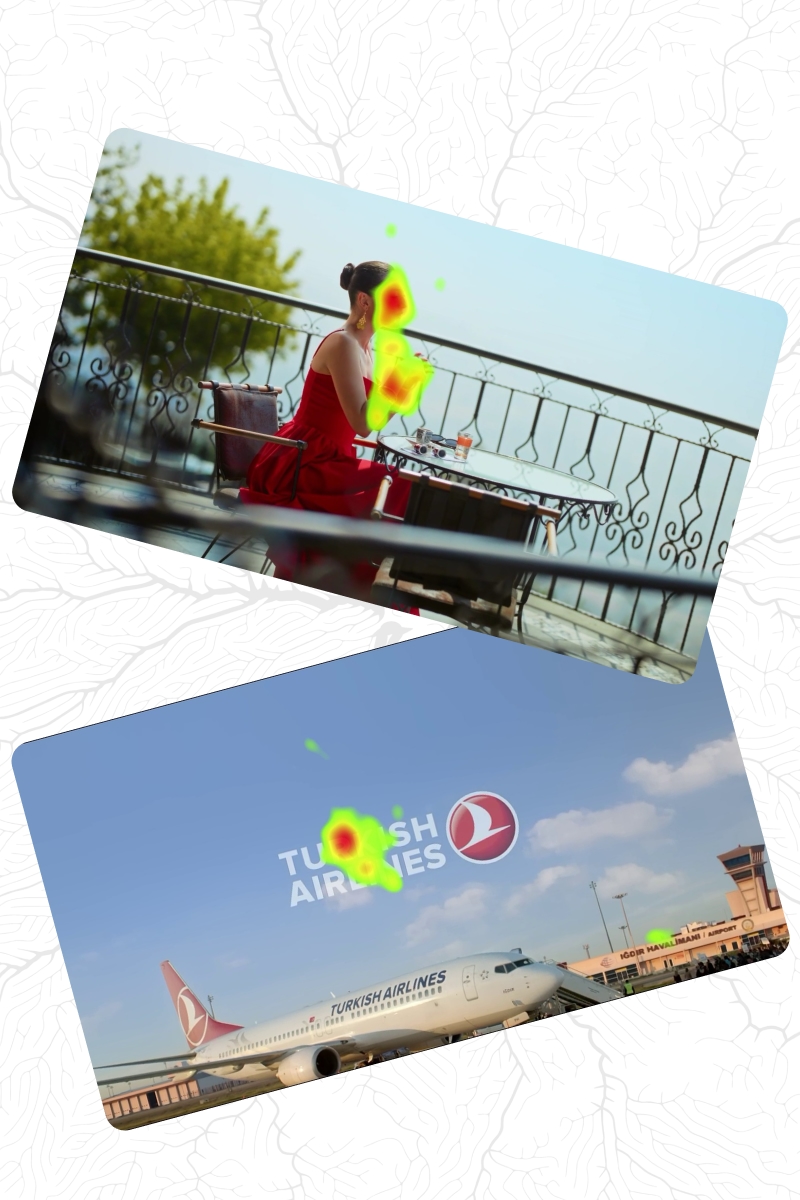
NEURO REFLECT | VAKA ANALİZİ
We Analysed Turkish Airlines’ Advertising Films Using Neuromarketing Methods
In the adverts ‘When You Imagine’ and ‘Discover Kahramanmaraş with Melis Sezen’, we examined the viewers’ attention, interest, physiological responses and what remained with them after watching the films.
We analysed Turkish Airlines’ ‘When You Dream’ advert—which made a name for itself in recent years, standing out for its powerful narrative and emotional tone—and its ‘Discover Kahramanmaraş with Melis Sezen’ advert—which has recently attracted attention for its use of a celebrity and its destination narrative—using neuromarketing methods.
We wanted to take a closer look at the impact these two adverts—each with their own distinct creative strategies—had on the audience, to understand which moments really worked, and to gain actionable insights for marketing purposes.
In the study we conducted with 29 participants, we used eye-tracking, EEG and GSR measurements simultaneously. This enabled us to observe, within the same timeline, where the viewer was looking, at which moments their level of engagement changed, and when their physiological arousal increased. We also analysed the post-film evaluations alongside this data.
In two different narratives from the same brand, where does the viewer’s attention go? At what moments does interest peak? To what extent do suspense, facial expressions, the destination and the brand make a difference? What remains after the film has ended?
Whilst the overall biometric results were similar during the screening, the assessments following the film showed a much more pronounced divergence. The most interesting aspect of the study was where and how this difference arose.
To watch the adverts Hayal Edince | Melis Sezen ile Kahramanmaraş’ı Keşfet
29 | 3 | 2 |
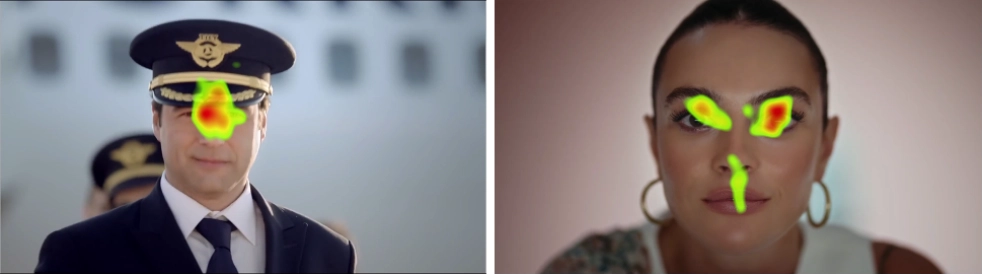
Selected eye-tracking heatmaps from two films. It can be seen that gazes are concentrated on human faces and, in particular, around the eyes.
At first glance, they seem similar, but over time they have become quite different
When comparing the two films as a whole, the first thing that stood out was that the biometric results at the film level did not differ sharply from one another. The EEG measures of mental engagement, physiological arousal and general eye-tracking metrics did not, on their own, indicate that ‘this film is clearly more compelling’.
The real difference became apparent when we analysed the films frame by frame. Whilst ‘Hayal Edince’ built a structure that gradually built up interest towards the finale, in ‘Melis Sezen’ powerful moments re-emerged in different scenes. This was one of the clearest findings demonstrating that two adverts with similar average ratings could create distinctly different experiences for the viewer.
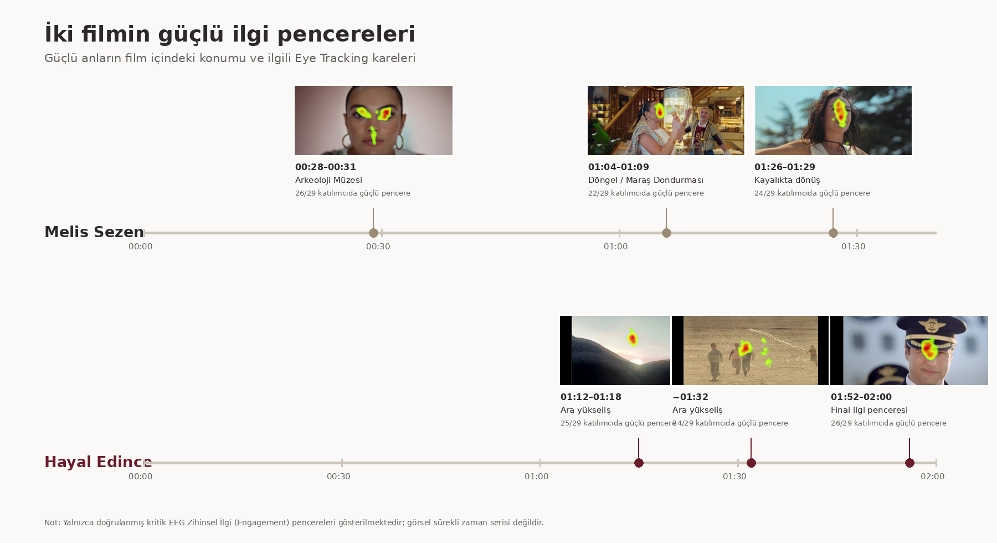
İki reklamda doğrulanan güçlü EEG Zihinsel İlgi pencereleri. Görsel sürekli EEG eğrisi değil, öne çıkan zaman aralıklarının film içindeki yerini gösteriyor.
The average for the advert tells us how much engagement it generated, whilst the timeline shows how that engagement developed. |
In Hayal Edince, the tension was palpable; the shared interest centred on the resolution
In “When You Imagine”, the scene where the aeroplane approaches the children is one of the film’s most striking moments. As the aeroplane descends, the narrative creates a brief moment of tension; the children look up, and the audience is left wondering how the story will unfold. This feeling was also reflected in the participants’ verbal feedback. Whilst some participants stated that they felt uneasy at this moment or that the scene made them feel a little on edge, one participant specifically noted that the aeroplane flew very close to the children. Rather than indicating that the scene was viewed negatively, these comments provide a qualitative indication that it succeeded in creating a genuine sense of tension prior to the resolution.
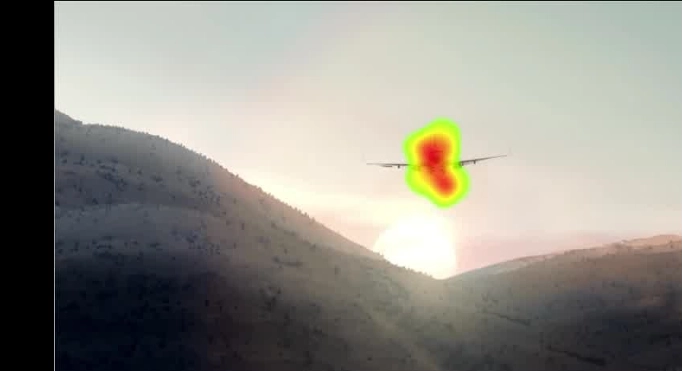
The moment the aeroplane approaches the children. The eye-tracking heat map shows that their gaze is focused on the aeroplane.
The data revealed something even more interesting here. Tension builds anticipation, but the most consistent peak in engagement does not occur during the aircraft’s noisy and tense flypast, but rather in the resolution phase immediately afterwards, when the pilot appears and begins to greet the children. Between 01:52 and 02:00, Mental Engagement exceeded the individual’s own film average in 26 out of 29 participants, or approximately 90 per cent.
The strong reaction at the end was not a single, sudden spike. Interim rises are observed in 25 out of 29 participants between 01:12 and 01:18, and in 24 out of 29 participants at approximately 01:32. The film builds interest in small waves and brings it together in the finale. Therefore, the phrase ‘gradually building interest towards the finale’ is not merely a creative interpretation, but the very pattern we observe in the timeline.
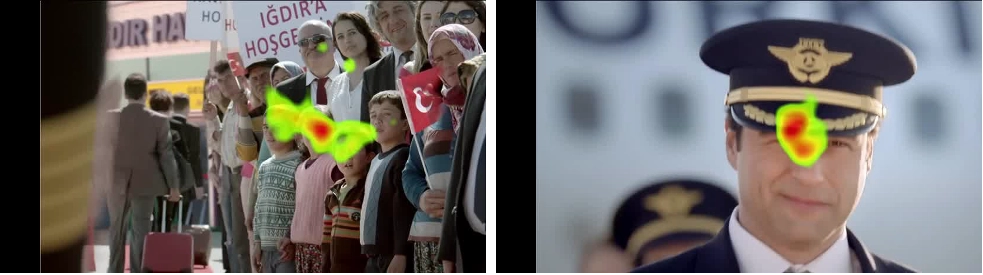
Selected eye-tracking frames from the finale of Hayal Edince. The gaze focuses on the children’s faces and then shifts to the pilot’s face.
The open-ended responses following the film also circled back to the same scene. The pilot noticing the children, waving to them, and the sense of warmth and connection were recounted time and again. One participant’s remark that ‘they realised they had been seen’ sums up quite well why the scene resonated so strongly.
The use of children here is not a formula in itself. The impact emerges in conjunction with a heartfelt story built around the children’s imagination, their anticipation and, ultimately, their being recognised. Whilst the children’s faces create a powerful visual focal point, the warmth of the narrative channels this attention towards a meaningful conclusion. This is also where the key distinction lies from a neuromarketing perspective. The fact that a face attracts attention is not the same as the meaning that face carries within the story.
The peak-end rule in behavioural science describes the tendency for experiences to be remembered primarily through their most intense moments and their final stages. The findings from “When We Imagine” are consistent with this framework. The most consistent window of interest occurs at the end; the section recalled after the film and reiterated in the reasons for preference is also this ending. This does not imply that the peak-end rule is the sole reason for the preference, but it provides a powerful framework for understanding why the film’s ending structure is so critical.
There is another important distinction here. Whilst EEG measures of mental engagement rose markedly during the finale, no significant increase in GSR (skin conductance) or heart rate was observed in the same section. A rise in engagement does not necessarily mean that the body is more aroused. It is precisely here that the value of using different measurement modalities in combination becomes apparent.
In Melis Sezen’s case, the interest isn’t solely down to a single final
In the film “Discover Kahramanmaraş with Melis Sezen”, however, there is a different rhythm. Moments of intense interest recur in various sections of the film. In the Archaeology Museum section, 26 out of 29 participants; in the Döngel Caves and Maraş Ice Cream section, 22 out of 29; and in the final powerful segment where the character reappears amongst the rocks, 24 out of 29 participants showed a level of interest exceeding their own average.
The eye-tracking finding in the close-up around 00:28 is particularly striking. When Melis Sezen looks at the camera, the viewers’ gaze is drawn directly to the area around her eyes. Eye contact in this scene clearly draws the gaze to her face. This same time interval corresponds to one of the strong EEG windows of interest, and an increase in skin conductance is also observed here. GSR does not tell us whether this arousal is positive or negative; it merely indicates that physiological activation has increased.
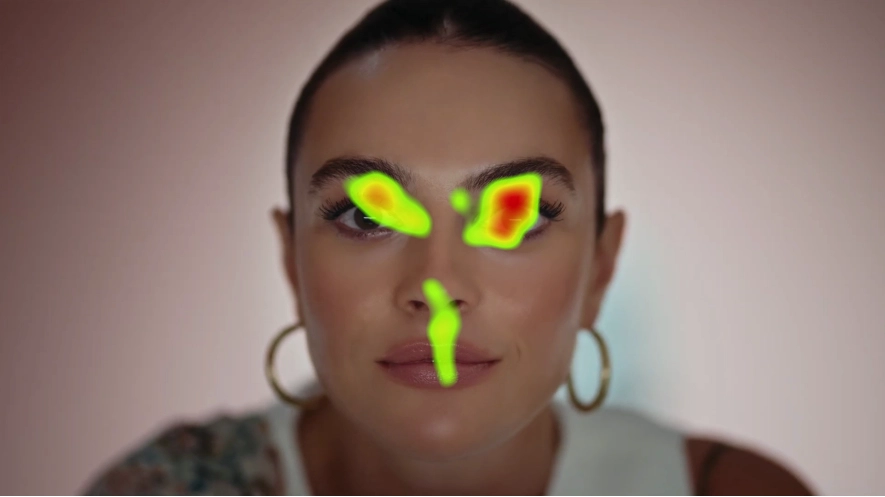
In the close-up shot of Melis Sezen looking at the camera, the intensity of her gaze is clearly concentrated around her eyes.
It is also interesting to note what the powerful moments have in common. Whilst scenes relying more heavily on the depiction of locations—such as Poets’ Hill and the mosque—also elicited notable reactions, the most consistent patterns of strong EEG activity among participants were observed during moments when the character actively engaged with people, local experiences or the setting. This contrast highlights the difference in destination marketing between merely showing a place and demonstrating to the viewer the kind of experience that could be had there.
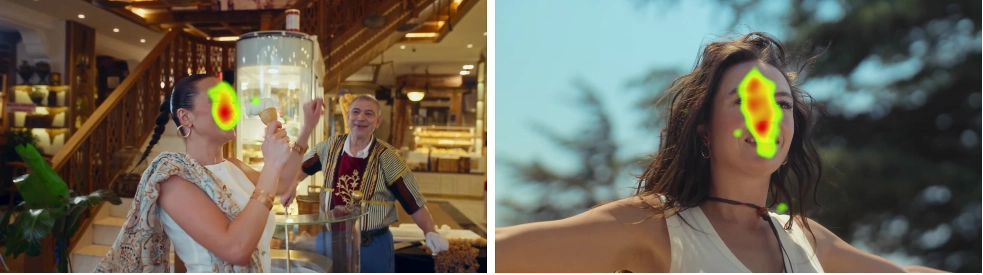
The scene featuring the interaction with the Maraş ice cream and the moment when the character reappears on the cliffs is one of the film’s most compelling moments.
The scene where the characters turn around on the cliffs is particularly striking. This sequence, which heightens the visual tension, constitutes the film’s final powerful moment of engagement. In the open-ended responses, some participants mentioned associations of artificiality and ostentation regarding certain parts of the film; whilst the brief interview notes included examples of some female participants expressing discomfort regarding the film. These findings cannot be generalised to all women. Nor was any film-specific tendency towards withdrawal (distancing) observed in the Frontal Alpha Asymmetry data from the EEG. The more cautious conclusion here is that strong attention and positive evaluation are not always one and the same thing.
The film’s faster editing pace and more frequent scene changes are also one of the differences in creative texture between the two adverts. A controlled editing test would be required to state that this directly explains the similarity in timing amongst participants. Nevertheless, comparing the fast and slower variants in a subsequent study could be a meaningful area for testing.
Being seen is not the same as being remembered
In terms of destination, both films provide interesting examples. The text ‘Iğdır’, which appears on screen for approximately 3.2 seconds in the early part of ‘Hayal Edince’, is seen by 93 per cent of participants. The ‘Welcome to Iğdır’ sign at the end is also in the frame, but it remains more secondary in the visual hierarchy, and attention quickly shifts to the people.
It is significant in this regard that the brief interview notes contain examples where some participants recalled the city in which the film is set with less clarity. The fact that a viewer sees a piece of information does not mean they retain it with the same clarity once the film has ended. Whilst eye-tracking answers the question ‘did they see it?’, recall is measured on a different level.
In Melis Sezen’s film, we see shots where the viewers’ gaze is drawn to the text area when destination text appears. The messages ‘Döngel Caves’ and, at the end, ‘Discover the beauty of Kahramanmaraş with Turkish Airlines’ demonstrate that destination information can function as a distinct visual focal point within the narrative.
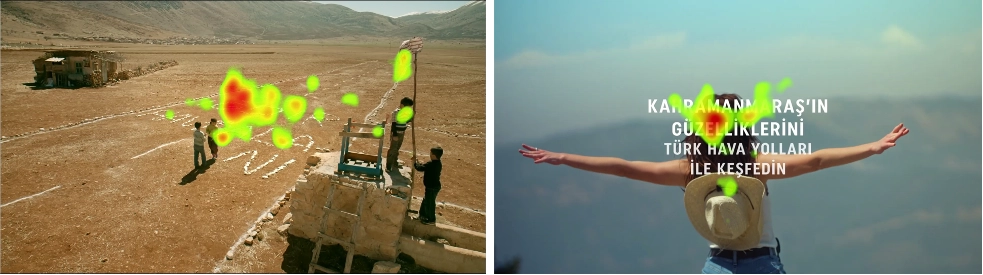
Destination codes function differently in the two films. Whilst the information about Iğdır achieves high visibility in the early part of the film, the closing message in the Melis Sezen film is shown directly on screen.
Hikaye ortak bir ritim kuruyor, keşif farklı temas noktaları açıyor
We also examined the extent to which the participants’ Mental Attention curves—which change from second to second—resembled one another. In the EEG recordings that passed quality control, this similarity was measured at 0.29 for ‘Hayal Edince’ and 0.12 for ‘Melis Sezen’. The trend remained the same in the sensitivity analysis conducted on the entire sample.
This result does not mean that ‘people’s brains became synchronised’ or that everyone was thinking the same thing. What it demonstrates is more limited and more practical. ‘Hayal Edince’ draws viewers into a more shared rhythm of interest at similar moments in the film. ‘Melis Sezen’, on the other hand, creates multiple powerful points of connection throughout the film. Whilst one establishes a shared structure in the resolution of the story, the other renews interest at different moments throughout the exploration. It is here that the strengths of the two strategies diverge.
The brand is visible; the real question is when it is seen
The THY logo appears with very high frequency in both films: 97 per cent in ‘Hayal Edince’ and 100 per cent in the film ‘Melis Sezen’. In contrast, in both films, only around 32 per cent of the EEG recordings—which passed quality control—were above the individual’s own average level of attention whilst the logo was on screen.
This figure certainly does not mean that ‘only 32 per cent saw the logo’. Eye-tracking shows exactly the opposite: the logo is seen by almost everyone. What the figure indicates is that the moment the brand appears does not coincide with the viewer’s peak window of mental attention.
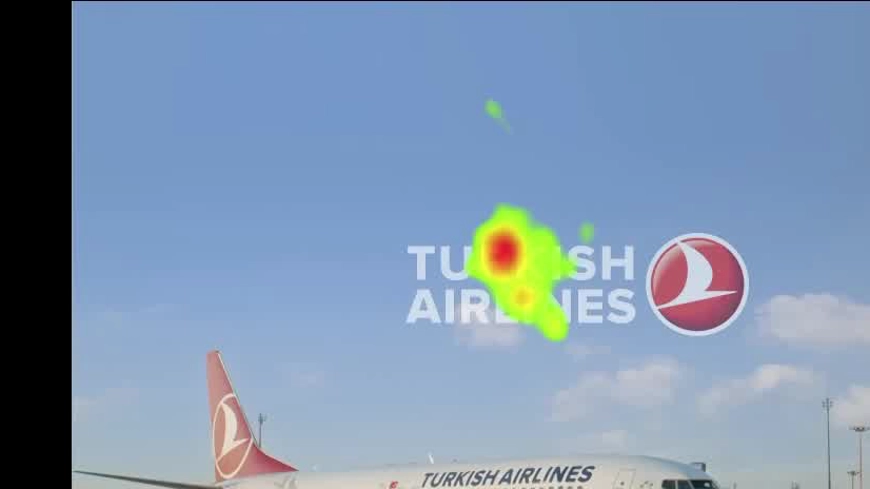
At the end of the ‘Hayal Edince’ advert, the THY logo achieves high visibility. The key to optimisation lies not so much in visibility as in the timing of the brand moment within the window of peak engagement.
The performance of smaller elements on the closing card also points to the same issue of visual hierarchy. In ‘Hayal Edince’, the hashtag’s visibility rate is 21 per cent, whilst Star Alliance’s is 45 per cent. In the film ‘Melis Sezen’, Star Alliance’s visibility rate is 62 per cent. The most practical question that arises from this is which element on the closing card should really take priority, and whether these elements compete visually with one another.
Once the film has finished, the difference becomes more apparent
Whilst biometric results during the screening were similar for both films, the conscious evaluations made after the screening showed a much more pronounced difference. 93 per cent of participants chose ‘Hayal Edince’ as the film they liked best. 97 per cent found the film more memorable, and 97 per cent also found it more emotional. 90 per cent stated that it evoked stronger emotions, whilst 86 per cent noted that they noticed the aeroplane more clearly.
The proportion of respondents who chose ‘Hayal Edince’ as the film that further increased their trust in THY was 83 per cent. This figure again indicates a strong majority, but shows a more limited divergence compared to other assessments. The fact that the significant difference in emotional preference and memorability is not reflected to exactly the same extent in the question regarding trust in the organisation is also one of the study’s notable nuances.
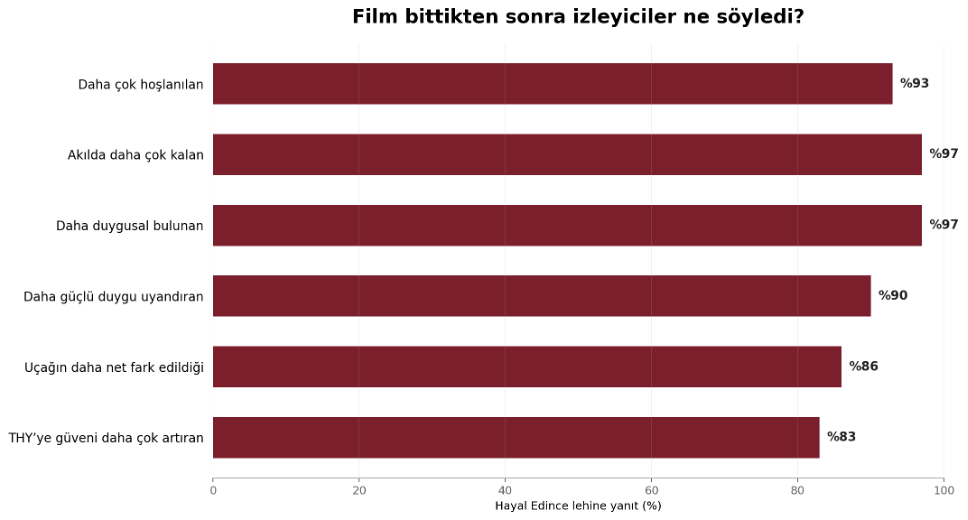
The proportion of responses in favour of Hayal Edince in the comparative evaluations following the screening.
This table also shows why neuromarketing measurements and self-reports are not mutually exclusive. Biometric measurements capture the process at the moment of viewing, whilst the post-film questions reveal what the viewer takes away from the experience. When interpreted together, these two layers provide a much clearer picture of how the creative works.
Looking at the study as a whole, quite concrete areas for testing emerge for both films. These include better aligning the timing of brand and destination information with key moments, strengthening the connection between the character and the local experience, and simplifying the visual hierarchy in the closing sequence. The aim here is not to judge the existing films as ‘right’ or ‘wrong’, but to see how their existing strengths can be utilised more effectively in the next creative project.
A few seconds can carry the whole film
In this study, both adverts have their strengths, but they draw their power from different sources. ‘Hayal Edince’ builds anticipation and brings the audience together at a shared climactic moment. ‘Melis Sezen’, on the other hand, keeps the viewer’s interest fresh throughout the film through facial expressions, movement, local experiences and rapid cuts.
Perhaps the most important finding is this: rather than judging an entire advert as ‘good’ or ‘bad’, it is far more useful to look at which specific moments really work. Sometimes that powerful moment isn’t found in a grand production sequence, but in a pilot’s brief greeting to the children.
If you’re wondering where the most powerful moment in your advert is, we can take a look together.
About the research
The study was conducted with 29 participants. Eye-tracking, EEG and GSR measurements were used simultaneously; post-film comparative assessments and open-ended responses were analysed alongside the biometric data. The EEG findings were further validated on 19 recordings that had passed quality control; synchronisation and segmentation findings were treated as exploratory in nature and were not interpreted as a targeting rule.
Visual note: Selected stills from the advertising films examined in the study have been used. The eye-tracking heatmaps and research visualisations were created by Neuro Reflect.